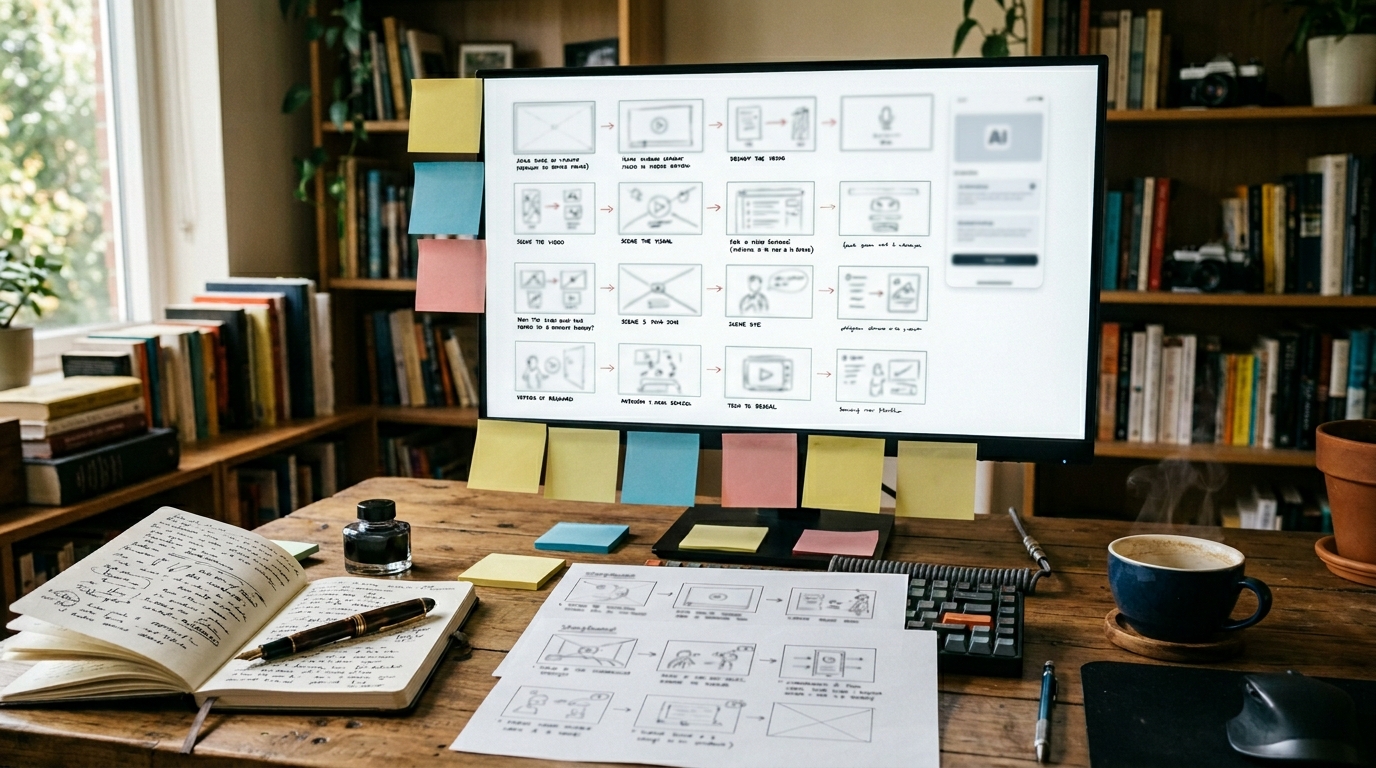
Every film, commercial or brand video is planned before it's shot, and two of the most useful planning tools are the storyboard and the animatic. They sit next to each other in pre-production and build on one another, but they answer different questions. The storyboard answers "what will each shot look like?" The animatic answers "how will the whole thing feel once it's cut together?" Confuse the two, or skip straight to shooting without either, and you invite a lot of avoidable reshoots and budget overruns.
What is a storyboard?
A storyboard is a sequence of static frames, drawn, photographed, or now AI-generated, that map a project out shot by shot. Each panel captures one moment: the composition, the camera angle, who's in frame, the key action. Around the frames you'll find short notes on dialogue, camera movement ("slow push in") and transitions. Think of it as the visual script. Its job is to get everyone, from the director and client to the DP and art department, agreeing on the same picture before a single euro is spent on set. Because the frames are still, a storyboard is fast and cheap to change. You redraw a panel; you don't re-edit a timeline.
What is an animatic?
An animatic is the storyboard set in motion. You take those static frames, drop them onto a timeline, and hold each one for the length its shot is meant to run. Then you layer in a scratch voiceover, temp music and rough sound effects. Suddenly the plan has a heartbeat. You're no longer looking at fifteen drawings; you're watching a thirty-second rough cut that plays at the real pace of the finished piece. Simple animatics are just the frames cut to time. Richer ones add basic camera moves, dissolves and even a little animation. The point isn't polish. The point is timing.
The core differences: static vs timed and scored
The gap between the two comes down to one thing: time. A storyboard is spatial. It tells you what a shot contains, but says nothing about how long it lasts or how it flows into the next one. An animatic is temporal. It tells you nothing new about any single frame, but everything about rhythm, pacing, and whether the edit breathes. A storyboard can't tell you a joke lands two seconds too late, or that a product reveal feels rushed, or that the music swells on the wrong cut. An animatic shows you all of that right away. The storyboard is silent and still; the animatic moves and has sound. That's why the animatic is where clients tend to catch problems they couldn't see in a stack of frames. Catch them here, on a laptop, and it costs nothing next to catching them on a shoot day.
Where each sits in the production process
The two are sequential, not competing. A normal pre-production flow goes: script and concept, then storyboard to lock the visual plan, then animatic to lock the timing and edit, then the shoot, then the real edit. The storyboard is the blueprint; the animatic is the walkthrough of the building before it's built. For a straightforward interview or a single-location piece, the storyboard alone is often all you need. But the moment a project depends on precise timing, say a music-driven commercial, a fast-cut social spot, or a brand film where every beat has to land, the animatic earns its place. It's the last cheap chance to be wrong before production costs kick in.
How AI now speeds up the animatic
The animatic used to be the expensive part of this pair. Turning static boards into a timed, moving rough cut meant an editor, sometimes an animator, and hours of work, which is exactly why smaller projects skipped it. That's changed. With tools like Runway, we now generate short moving clips straight from storyboard frames, so instead of holding on a still drawing, each panel becomes a few seconds of real motion. The animatic stops being a slideshow and starts to feel like the film. What used to take a day of editing now takes an afternoon, so even mid-size projects can afford a proper animatic, and clients react to something that genuinely moves rather than imagining the gaps.
At PAM Istanbul this is a big part of what we do: using AI to compress the pre-production loop without losing the craft. We build the storyboard, then generate an AI animatic from it so the timing, pacing and mood are all agreed before we schedule a shoot day. That means fewer surprises, faster client sign-off, and a production plan everyone has already watched move.
Let's build it together.
We've been producing commercial film and photography since 2018, and for the last three years we've been integrating AI into our workflow. We mentor your team as we produce: transparent process, documented decisions, no black box. We set up your brand's AI production together, built for sustainable growth.
Email: [email protected]
Phone: +90 530 267 49 29
Studio: Yayıncılar Sok. 10/3, Seyrantepe · Istanbul