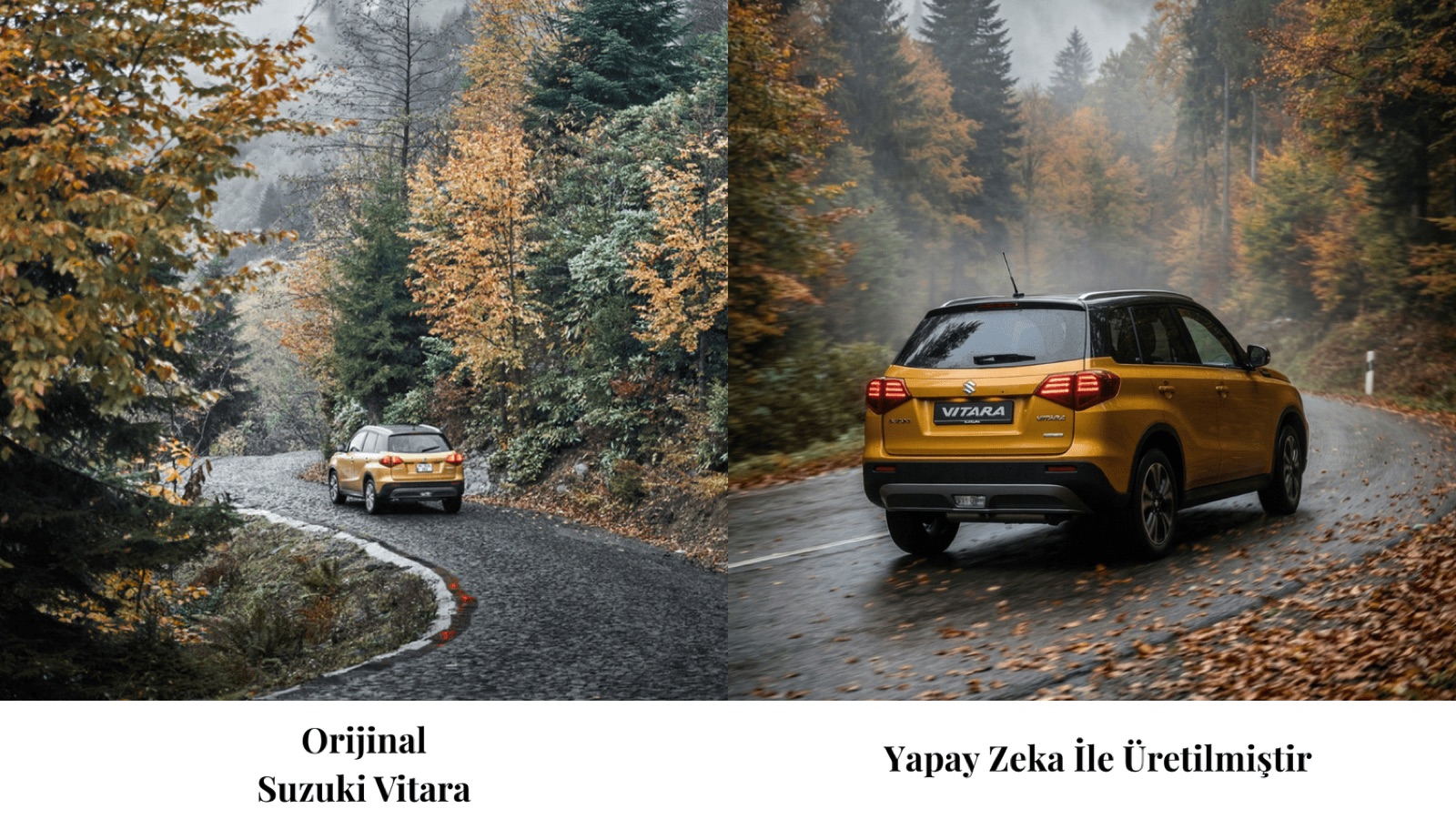
Automotive advertising faces a fundamental challenge: a car is never truly static. Even at rest, it must communicate motion. Its metal, glass and paint surfaces refract light differently from every angle. A single highlight line on the bodywork either reveals the car's design language or erases it. In a discipline this precise, AI brings significant opportunity — and equally significant risk if deployed without photographic expertise.
The Automobile as Moving Architecture
At PAM Istanbul, our approach to automotive production comes from an architectural perspective: a building is static structure; a car is moving architecture. This framing changes everything.
The discipline of managing morning light across a building facade translates directly into controlling highlight lines across a vehicle's bodywork. The aerodynamic forms, the depth of paint quality, the way glass surfaces enter into dialogue with their surroundings — these are all the visual expression of engineering decisions. A production team that can read them accurately can build a true visual narrative for the vehicle.
AI Studio: The Mathematics of Reflections
Reflections are the defining technical challenge of automotive production. A car's bodywork behaves like a near-perfect mirror — it absorbs and reflects everything around it. The hardest problem on a traditional set is preventing the background or studio equipment from appearing in the paint.
PAM AI Studio turns this physical problem into an advantage. Through mathematical modelling of light behaviour in a digital environment:
- Highlight lines that define the vehicle's design language are set with pixel-level precision
- Bodywork reflections are controlled to convey the intended atmosphere
- Night shoot, sunrise, overcast studio light — unlimited lighting scenarios from a single vehicle
- The hours-long search for "perfect reflections" on a traditional set moves into a digital laboratory
Location Without Logistics
In automotive advertising, environment is a central narrative tool. Placing an SUV on a muddy off-road course, positioning a city car against a nighttime Istanbul skyline or pairing an electric vehicle with a minimalist Scandinavian landscape — each targets a distinct customer emotion.
Traditional production would require separate location shoots for each: permits, transport, weather dependency, logistical complexity. With AI Studio:
- A studio-captured vehicle can be placed in any geographic context
- The physical texture and light interaction of the vehicle is preserved while the background atmosphere changes completely
- Brands complete an entire campaign's visual needs from a single production session
- Campaign timelines compress dramatically — waiting for ideal conditions disappears from the schedule
Colour Variants and Configuration Imagery
If a vehicle has eight colour options, the traditional approach requires either shooting eight vehicles or applying digital colour grading to a single capture. Both are expensive and time-consuming.
In the AI hybrid approach, all colour variants are generated from a single reference capture. The metallic depth and lacquer quality of the paint is preserved; the vehicle geometry stays locked; only the colour changes. The result is a consistent, technically accurate set of visuals aligned to brand colour language.
For digital showrooms and automotive e-commerce platforms, this approach creates significant cost advantages. Shooting every combination of 10+ colours and 5+ trim levels separately is no longer a requirement.
The PAM Istanbul Automotive Production Process
We approach automotive projects not as photographers but as visual engineers:
- Brand brief analysis: The vehicle's design language, target audience and campaign message are clarified. Which lighting atmosphere, which spatial context, which emotional register?
- Capture planning: Which angles go to studio shooting, which go to AI generation — decided upfront
- Studio capture: Critical angles, detail shots and lighting references captured
- AI Studio production: Atmosphere, location variations, colour options and motion sequences generated
- Post-production integration: Studio and AI outputs merged with a locked colour language
- Format delivery: Digital media, print, outdoor billboard, social media and showroom screens
Where Automotive Visual Production Is Heading
The convergence of CGI and AI is opening a new era in automotive advertising. Campaign visuals can be produced before the vehicle enters production. Pre-launch marketing runs entirely on virtual imagery. Customer testing for colour and configuration decisions happens in digital environments.
But inside all this technology, human judgement remains critical: which highlight line makes the vehicle iconic? Which background atmosphere conflicts with the brand's values? These questions are still answered by an experienced visual production team's eye — not an algorithm.
Let's discuss your automotive project. We'll tell your brand's vehicle story at the visual quality it deserves.
Contact: [email protected] · +90 530 267 49 29 · Yayıncılar Sok. 10/3, Seyrantepe · Istanbul