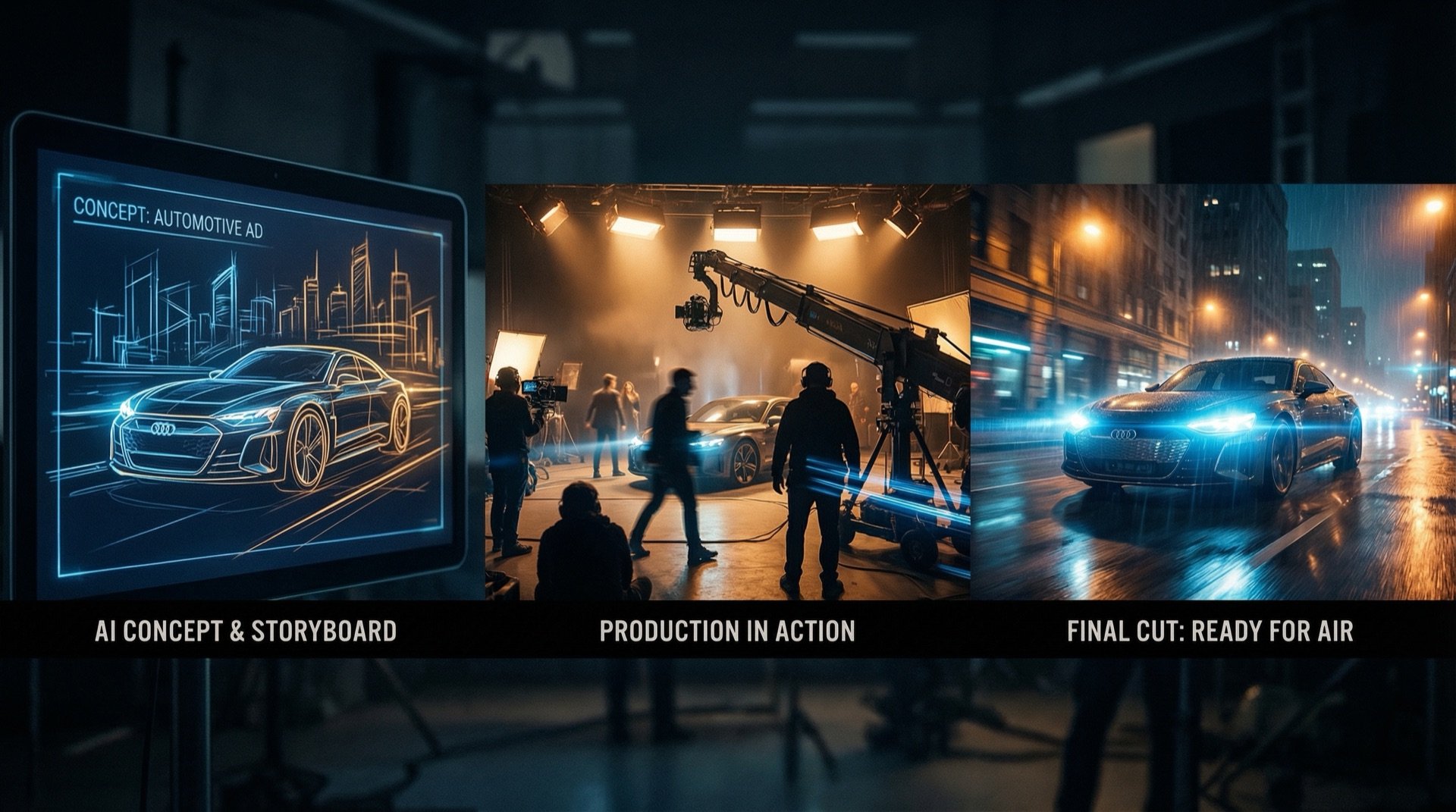
At PAM Istanbul AI-LAB the answer is clear: No — but not integrating AI into production is no longer an option either. Here's what actually shifts in 2026, and what a professional production pipeline looks like when it gets the balance right.
What AI changes in commercial film
1. Pre-production accelerates
AI compresses storyboard and animatic work dramatically. Concept frames in Midjourney or DALL-E land in minutes. The client approval conversation gets sharper because the idea is no longer abstract — it's visible.
At PAM Istanbul, AI moodboards carry clients into campaign atmosphere before the first call sheet ever prints.
2. Post-production cost drops
Colour, background work, VFX and motion graphics all move faster with AI assistance. For the short-form social formats that now dominate delivery, the compression turns days into hours.
3. Multi-format delivery gets real
From one shoot day, TV spots, YouTube pre-roll, Reels, TikTok and banner versions now come out of the pipeline with far less manual adaptation. AI handles the format-to-format logic.
4. Testing and iteration shorten
A/B variants, alternative voice tones, scene alternates — all reachable in minutes. Campaign performance can now be optimised after the shoot, not only before it.
Where AI still can't carry the spot
The output is impressive. The gaps are real:
- Brand consistency: AI doesn't internalise the visual DNA of a brand. Palette, lighting grammar and aesthetic coherence still need professional direction
- Emotional resonance: scenes that land emotionally — natural expression, authentic interaction — still come from real actors on a real set
- Sound and music: AI voice can still drift into uncanny territory. Professional VO and original score multiply effectiveness
- Legal certainty: AI-generated imagery rights remain unresolved in enough jurisdictions that broadcast and international campaigns still favour traditional capture
The hybrid model: how PAM Istanbul AI-LAB runs it
We're not tied to AI or to traditional methods. The hybrid production model combines the best of both:
- Concept stage: AI moodboard + creative director sign-off
- Storyboard: AI visualisation + professional revision
- Shoot: professional set crew + AI-assisted B-roll
- Post-production: human edit + AI acceleration
- Delivery: multi-format optimisation with AI
With this model production timelines shorten by 30-40%, budget efficiency goes up, and creative quality doesn't drop. If anything it rises at the pre-viz stage.
Commercial film production costs: realistic 2026 numbers
"How much does a commercial cost?" has no single answer; it all depends on scope. But to draw a realistic frame, you can split production into three scales. The ranges below are approximate and shift with the brand, the crew and the location requirements.
Low budget (digital-first, social-led): one location, a small crew, a single shoot day. Done traditionally, even this tier demands a substantial budget. With a hybrid AI approach — AI scenes instead of a full set, AI B-roll and fast editing — that cost comes down clearly, and the gap widens when you need several social formats.
Mid budget (brand campaign, TVC + digital): a few locations, a cast, professional lighting and sound, a two-to-three-day shoot. Here AI doesn't change the cost completely, but it saves real money in pre- and post-production; location variations and multi-format outputs come from AI.
High budget (national campaign, celebrity face, large production): in this segment shoot quality and brand assurance aren't up for debate. AI plays a supporting role in storyboard, pre-viz and alternative scene generation, not a replacement for the main shoot. The bulk of the cost line items — crew, location, equipment, talent rights — stays in place.
In short, AI creates its biggest cost advantage in the low and mid segments, especially where you need many formats and variations. On high-budget work it runs as an accelerator and a risk reducer.
Five questions to ask before choosing an agency
Plenty of agencies promise AI-assisted production, but they don't all work to the same discipline. To pick the right partner, ask these five:
- 1) Where and why do you use AI? A good agency doesn't force AI into every scene; it uses AI only where it adds value and handles the rest with real capture. "We do everything with AI" is a warning sign.
- 2) How are rights and usage secured? They should be able to explain clearly where AI-generated imagery stands on copyright for broadcast and international use.
- 3) How do you keep brand consistency? They need a system for colour language, lighting character and aesthetic coherence — "it came out nice" isn't enough.
- 4) Is the process transparent? Can they document which stage was AI and which was a human decision? Avoid black-box processes.
- 5) Is there reference work and real experience? A team that has used AI tools on real client projects, on real sets — or only in demos? The portfolio shows it.
Which brands should make AI-assisted commercials?
The AI-assisted hybrid model fits these brands especially well:
- E-commerce brands: those needing fast, high-volume product videos
- Digital-first brands: social-led, with a constant need for multiple formats
- Launch campaigns: projects that need fast concept testing and iteration
- Global brands: campaigns requiring multi-language and multi-market adaptation
Talk to us
If you want to explore how AI can work on your commercial, get in touch with the PAM Istanbul AI-LAB team. We build a hybrid production plan and budget optimisation around your project's scope.
Contact: [email protected] · +90 530 267 49 29 · Yayıncılar Sok. 10/3, Seyrantepe · Istanbul