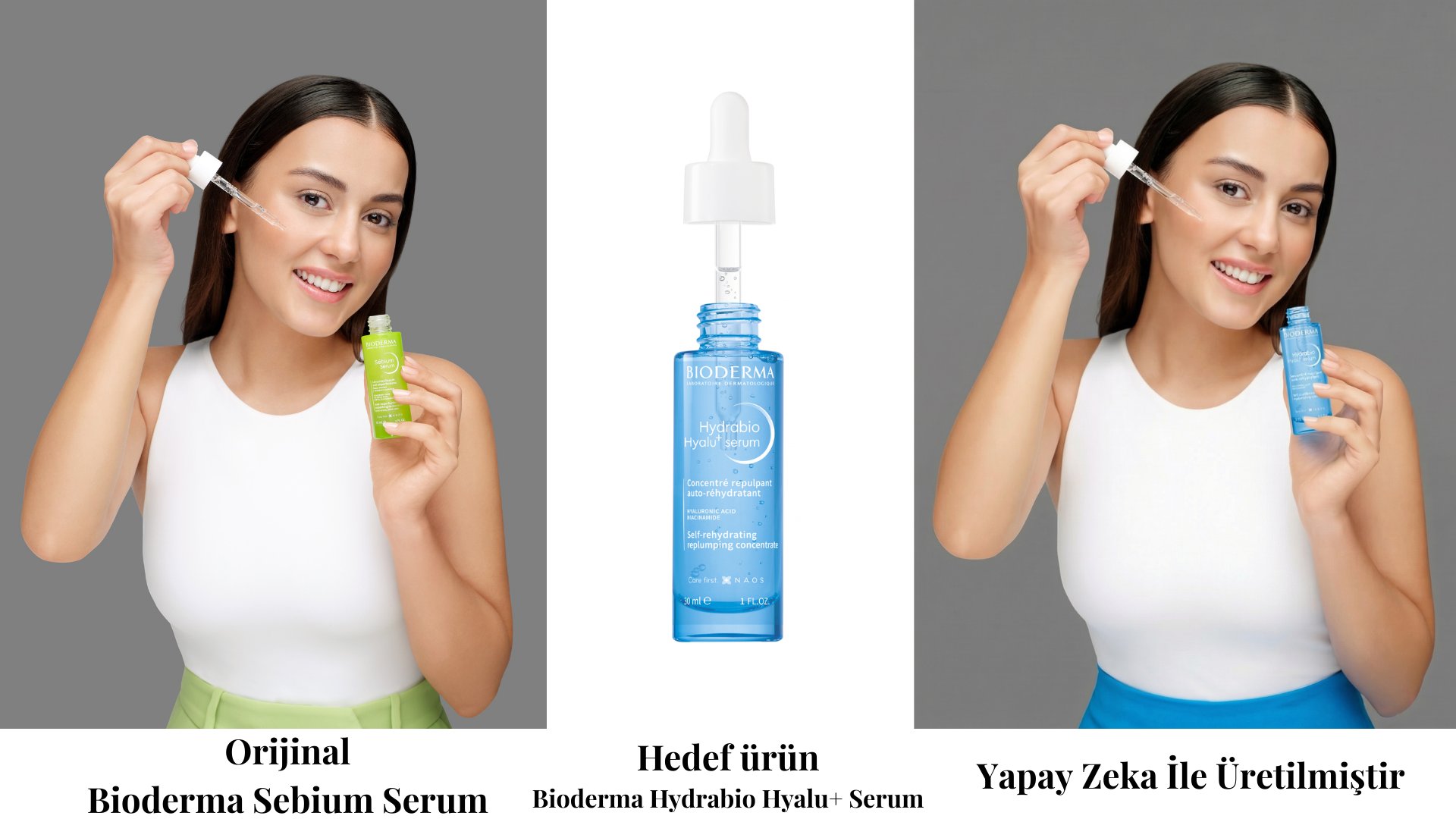
At PAM Istanbul we treat high-end cosmetic production as an art form. Here is the anatomy of a professional shoot, and the story of how AI-LAB takes that process up a level.
1. The language of texture: swatch and macro
In cosmetics, texture is everything. The flow of a product or its matteness can only be told through the right lens and the right light. That means conveying the lip-curve smoothness of a lipstick swatch, or the velvety dust spread of an eyeshadow.
Lens choice decides a lot here. For lipstick swatches we usually reach for a 100mm macro; that distance lets us get close to the product while still blurring the background enough. For glass bottles and lotion pumps, the circular glare a ring light produces emphasises the round form of the bottle and creates a controlled sense of luxury. Matte-textured products — pressed powders in particular — present a different problem: keeping the surface's "velvet" quality without losing detail takes a combination of diffuse side light and a very low ISO.
Matte versus glossy isn't only an aesthetic distinction, it's a fully technical one. Hit a matte surface with too much light and the texture vanishes, leaving a flat grey smear. On a glossy surface, an uncontrolled reflection makes the product look cheap. Every cosmetic product needs its own lighting recipe.
AI still can't imitate, from scratch and in real physical terms, how a cream absorbs and reflects light. So we photograph your product first in our studio, at the highest resolution and under the most accurate light.
2. Bottles and packaging: controlling reflections
Cosmetic packaging usually has difficult surfaces — glass, metal, glossy plastic. Unwanted reflections can make an image look amateur. So how do you manage them?
For glass bottles, the most common approach is a light tent. It wraps the product in even, diffuse light from every direction and kills harsh reflections. But on its own that isn't enough, because the sharp glint on the "head" of a perfume bottle tells the brand's story and has to be kept. So we use the light tent together with flags (light-blocking cards) — holding the glints we want and snuffing out the ones we don't.
Metallic surfaces aren't the same as glass. An aluminium cap or a copper tube behaves completely differently from a glass bottle under the same setup. To reflect the "warmth" of metal we choose a tungsten-coloured fill light; for a cold metal aesthetic, a blue-white key. AI tools are very effective at cleaning up the remaining unwanted reflections in post, especially on curved surfaces.
With our lighting team, we direct every glint on the packaging so it serves your brand's prestige. For us each reflection is a signature that proves the product's quality.
3. Hybrid cosmetic production: the AI-LAB shift
This is where we make a real difference. In a traditional shoot, showing a product "in a luxury spa" or "in a tropical forest" means big logistical costs — flights, location fees, transport, set building.
Most global cosmetic brands now run a hybrid workflow. The production partners of brands like L'Oréal, Maybelline and MAC turn a product image captured in the studio into dozens of campaign variations with AI. In Turkey the trend is settling in fast too.
Here's how we run the process at PAM AI-LAB:
- Studio capture: we photograph your product in the studio in its most physically perfect form. This is the base record where texture, reflection and colour are all real.
- AI environment design: our AI-LAB team places that "real" product into generatively designed environments — minimalist white marble, tropical leaves, a luxury spa towel, a summer-sunset beach.
- Campaign variations: from a single studio shoot we produce separate image sets for different campaign periods like summer, winter, Valentine's Day and Mother's Day.
The ROI of this is concrete. In an analysis we ran for a cosmetic brand, the hybrid model cut the cost per image markedly against a traditional multi-location shoot, while multiplying output.
4. Colour fidelity and post-production
In cosmetics, colour drift isn't just aesthetic, it's a commercial problem. A customer orders online, opens the box, sees the colour is different from the photo, and you get a return, a bad review, a damaged brand. So colour accuracy isn't up for negotiation.
Lip products (lipstick, lip liner) make colour matching especially hard. Red tones can read both warm and cold on screen; a lipstick shot in standard sRGB looks different in Adobe RGB and different again converted to CMYK. With foundation shades, 20 different numbers have to stay distinguishable from one another — impossible without a colour chart (ColorChecker) at the shoot and ICC profile management in post.
We use calibrated monitors and a colour chart on every shoot. In post we compare the Pantone reference on the packaging against the on-screen colour and measure the gap. AI upscaling tools come in at the final stage: frames shot in low light, carrying noise, get cleaned and lifted to billboard quality without losing texture. The "velvety" shimmer of powder pigments is preserved here — the wrong sharpening tool destroys it.
Why PAM Istanbul
We don't just press the shutter. We deliver the three things a cosmetic brand needs — speed, aesthetics and trust. Our production crew captures the texture of the real world, and our AI-LAB team blends those frames with the reach of the digital age. The result: visuals at global standards, delivered at Turkey's speed.
Talk to us about your cosmetic project · [email protected] · +90 530 267 49 29 · Yayıncılar Sok. 10/3, Seyrantepe · Istanbul